Graduate Division of Biological and Biomedical SciencesMicrobiology and Molecular Genetics

MMG HomePage
Program Overview
Prospective Students
Areas of Research

Curriculum


Course of Study

Course Work

Course Descriptions

Elective Courses


Faculty
Students
Research Environs and Affiliate Resources
Graduate Division of Biological and Biomedical Sciences


Course of Study


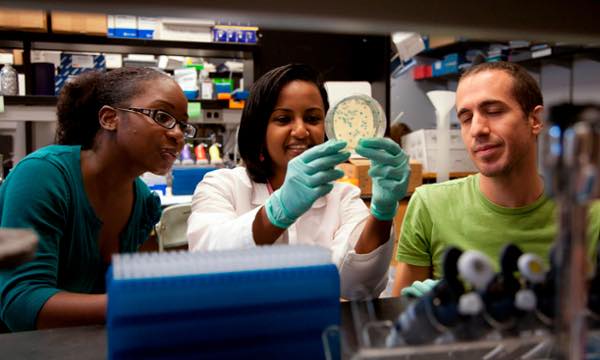
The graduate experience in MMG begins with an introduction to the faculty, current students, and their research through a series of short talks, discussions and a poster session. The students then choose the first of three research rotations which are designed to provide exposure to different areas and to varied techniques, and to enable the student to choose a laboratory for thesis research. These rotations, which often begin in the summer prior to matriculation in the Program, are usually completed in the second semester.

Each student is assigned a pre-research advisor for consultation in design of his/her individual curriculum. The Microbiology and Molecular Genetics Program is small and therefore can be tailored to the needs of each individual student. Therefore, after the first semester, in which all students take the same required courses, with the help of an advisor, each student selects different elective courses to fulfill the requirements for the Ph.D. Currently, most students take 3-4 full courses (> 4 credit hour) in the first year and 2-3 in year two.


Course Work


The following courses (or their equivalents) are required of all students in the Microbiology and Molecular Genetics Program:

Fall Semester
  COURSE TITLE CREDITS
IBS 504 Intro Prokaryotic Genetics 6
IBS 555 Principles of Basic Biomedical & Biological Science 6
IBS 545r Intro to Research 1
IBS 743r Experimental Approaches to Microbiology VC
MMG 597r Lab Rotations VC
MMG 792r Colloquium in Microbiology 1
 
Spring Semester
  COURSE TITLE CREDITS
IBS 545r Intro to Research 1
MMG 597r Lab Rotations VC
MMG 792r Colloquium in Microbiology 1
IBS 513 Virology 5


Course Descriptions


IBS 504: Intro Prokaryotic Genetics - Dr. June Scott

This is an introductory course in bacterial genetics for students who have had, or are currently taking, Biochemistry. It is designed to help students make the transition between large lecture courses and independent creative scientific thought. It also emphasizes oral communication. In the first third of the course, students are introduced to the basic terms and concepts in molecular genetics of bacteria and their viruses, including the mechanisms of genetic exchange and regulation of gene expression. The following segments of the course are devoted to reading and interpreting original papers in the field, both classical and contemporary. In discussion format, the students are encouraged to question conclusions in the papers and to design experiments to test "facts". Small sessions (voluntary) explain and discuss techniques in molecular biology and genetics applied to bacteria.

In addition to the Course Director, Drs. Moran and Rather actively participate in the course.


IBS 513: Graduate Virology - Drs. Rama Amara and David Steinhauer

A sound fundamental knowledge of molecular biology, biochemistry, and cell biology are recommended prerequisites. The course is taught in Spring, so most first year students will be prepared if they have taken Biochemistry in the previous Fall semester.

The graduate virology course is designed to provide a strong background in the basic concepts involving of viral replication, pathogenesis, and immunity. This is an interactive course in which several MMG and IMP faculty members are active participants. The first half of the course focuses on concepts that are applicable to viruses in general, and includes classes that cover virus structure, host cell entry, RNA virus transcription and replication, DNA virus transcription and replication, Retroviruses and retroviral integration, processing and translation of viral RNAs, virus assembly and exit, chronic infections, viral pathogenesis, viral immunity, and immune evasion. The second half of the course concentrates on specific virus families with an emphasis on human pathogens. In this half of the course faculty members generally lecture on the viruses that their individual research programs are focused on. In addition to the Course Directors, Professors Speck, Mocarski, Spearman, Hunter, Grakoui, Jacob, Altman, Ahmed, Compans, Plemper, Gooding, Lukacher, and Derdeyn, are actively involved in the course, and several guest lecturers from the CDC participate as well.


MMG 792r: Colloquium - MMG Program Faculty

This course instructs first and second year MMG students in the organization and presentation of research endeavors. Students are trained in computer programs for figure and slide preparation and use of photo documentation systems. Presentations of journal articles and personal research in progress are evaluated by both attending students and the faculty organizers.


IBS 545r: Introduction to Research - MMG Program Faculty

This course familarizes entering students with the research programs of the MMG faculty and facilitates the choice of laboratory rotations. Teaches research interests, methods and procedures for genetics, immunology and virology. Emphasis is placed by the faculty on the research and laboratory techniques applicable to respective research areas.


IBS 743r: Experimental Approach to Microbiology - MMG Program Faculty

Through experimentation brings together molecular biology, cell regulation, molecular genetics, molecular and animal virology, as well as host/parasite-oriented medical microbiology. This lecture and lab course is tailored to the individual student.


MMG 597r: Lab Rotations - MMG Program Faculty

Students are encouraged to arrive at Emory in the summer before their first semester in order to begin laboratory rotations. This provides the chance to become familiar with a laboratory and surroundings before courses begin. At the start of the semester, students attend sessions in which Program faculty describe their research and students who have not been at Emory during the summer can begin rotations following the presentations. Most students identify a lab for their dissertation studies during the second half of the second semester. Students are expected to perform at least 3 rotations. These are intended to familiarize the student with diverse techniques and allow selection of a laboratory in which to perform thesis research. The student presents a brief report of the research he/she performed in each rotation to the DGS.


Elective Courses


The only specific requirements in the program are those listed above. All students are required to take these courses. However, each Ph.D. student must meet minimum requirements of the Graduate School of Arts and Sciences with regard to total credit hours in course work. For each Ph.D. student an individualized program of advanced courses will be organized in consultation with the student's advisory committee and the Program Director. However, some courses are particularly appropriate for students in the Microbiology and Molecular Genetics Program. Following is a list of electives. * Note that some of the courses are not offered every year. It is recommended that students use the registrar's record to obtain an updated list of electives.


  COURSE TITLE CREDITS SEMESTER
OFFERED
IBS 505 Human & Molecular Genetics 4 Spring
IBS 515r Current Topics in Molecular Genetics 4 Fall & Spring
IBS 542 Concepts of Immunology 4 Fall
IBS 556 Principles of Basic Biomedical and Biological Sciences II 6 Fall & Spring
IBS 560 Model Genetics Systems 4 Fall
IBS 562 Molecular Biology of Cancer Metastasis 3 Fall
(every 3 years)
IBS 723 Molecular Animal Virology 3 Fall
IBS 725 Prokaryotic Gene Expression 4 Spring
IBS 726r Advanced Microbiology VA Fall & Spring
IBS 727 Genetics of Bacterial Pathogenicity 6 Spring
(every 3 years)
IBS 739 DNA Rearrangements and Gene Regulation 4 Fall
IBS 742 Regulation of Cell Growth 6 Spring
IBS 744r Exper. Approach to Immunology VC Fall & Spring
IBS 745 Infection & Immunity 6 Fall
(every 2 years)
IBS 777r Annual Reviews of Immunology 2 Spring


  | Program Overiew | Prospective Students | Areas of Research | Curriculum | Faculty | Students | Research Environs & Affiliate Resources | Pages |

| GRADUATE DIVISION OF BIOLOGICAL AND BIOMEDICAL SCIENCES |


COPYRIGHT © 2007 EMORY UNIVERSITY